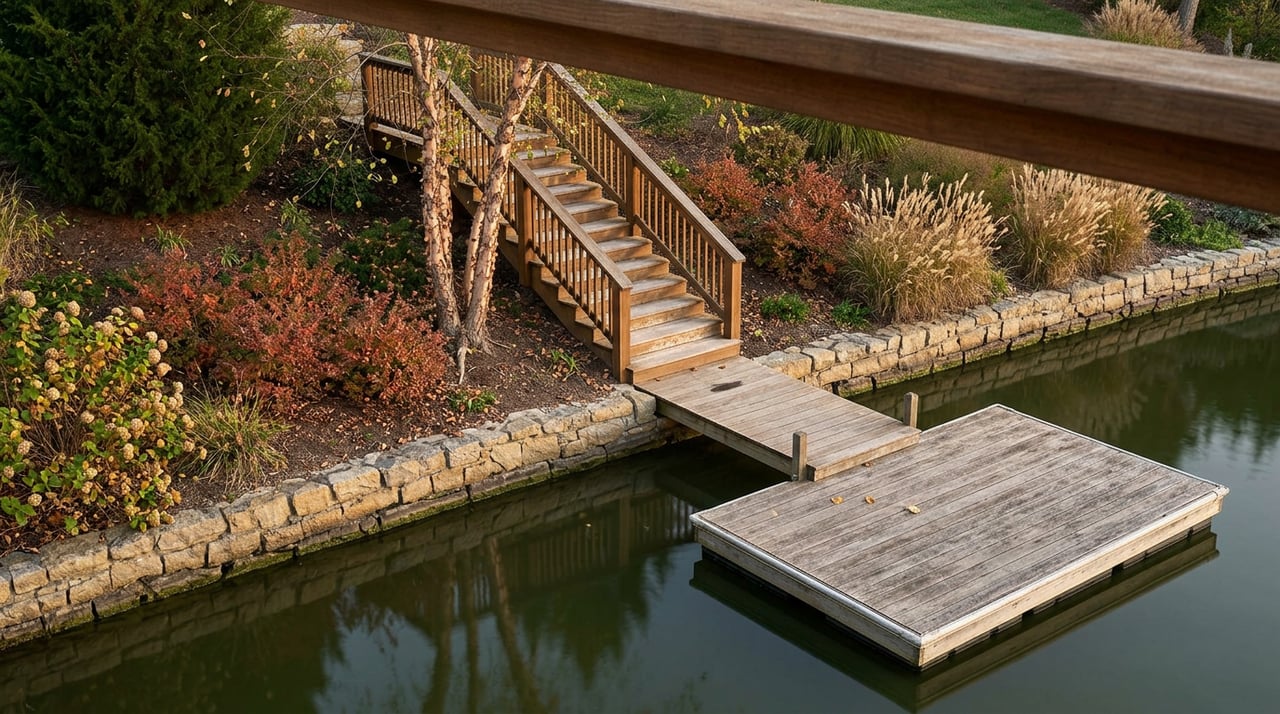
A buyer closes on a home on Arley's stretch of Smith Lake in late spring, moves in over the summer, and decides in August to swap the aging single-slip dock for a covered boat lift before the season ends. The contractor asks for the Alabama Power permit number so the new structure can be built against the existing footprint. The buyer digs through the closing file. There is a survey, a septic report, an appraisal. There is no dock permit, because the dock permit was issued to someone who sold the house eleven years ago and never told anyone it changed hands.
This is not a rare mistake. It is the default outcome of how Smith Lake shoreline law actually works, and almost nobody explains it clearly before closing.
A License, Not a Fixture
Buyers treat a dock the way they treat a fireplace or a built-in bookshelf: a physical thing attached to the property that conveys with the sale. On Smith Lake, that assumption is wrong in a way that has real financial consequences.
Alabama Power owns the lake bed and the shoreline up to the boundary of its FERC license for Smith Dam. What sits on a homeowner's dock is not a piece of real property that transfers by deed. It is a permit issued to a specific person, granting that person permission to use Alabama Power's land and water for a private structure. The company's own guidelines are explicit that it retains full authority to raise, lower, restrict, or otherwise control the reservoir in any manner it decides, regardless of what a homeowner has built on the shoreline.
That distinction matters at the exact moment a house changes hands. A house's foundation transfers automatically at closing because it is part of the real property. A dock permit does not transfer automatically, because it was never real property to begin with. It is closer to a permit to park in a specific spot than an easement recorded against the land.
Why the Confusion Is the Point
Search for how Smith Lake dock permits transfer at sale and different sources will tell a buyer opposite things. Some describe the license as transferable, provided the new owner files paperwork and pays a fee. Others state flatly that the permit is extinguished the moment the property sells, full stop, with the incoming owner starting from zero.
The actual rule sits between those two claims, and the gap is exactly where buyers get hurt. Alabama Power's guidelines require the current permit holder to notify the company in writing of the name and address of the person the property is transferring to, and to do so at least seven days before the transfer takes place. That is not automatic transfer. It is also not a hard reset to zero. It is a continuation that depends entirely on the seller actually doing the paperwork, and closing checklists rarely flag it the way they flag a survey or a termite letter. If the notice never gets filed, which it frequently does not, the dock sits there in plain sight while its underlying permission has quietly lapsed with no one on record to answer for it.
A second, smaller confusion compounds the first. Several real estate sites describe Smith Lake's "normal pool" as 522 feet above mean sea level. That number is real, but it is not a water level. It is the elevation of Alabama Power's flood easement, the line up to which the company's permitting authority extends on the shoreline. The lake itself sits far below that most of the year. Summer full pool runs near 510 feet MSL, and the company begins a scheduled drawdown each July that brings the lake down to a winter pool near 496 feet by mid-November, a swing of roughly 14 feet. Conflating the easement boundary with the actual water surface is an easy mistake, and it shows up often enough in agent-written guides that a buyer relying on any single source is likely to walk away with the wrong number.
| Elevation (MSL) | What it means | |
|---|---|---|
| Summer full pool | ~510 ft | Peak recreational water level, held through summer |
| Winter pool | ~496 ft | Lowest scheduled level, typically reached mid-November |
| Flood easement boundary | 522 ft | The line up to which Alabama Power's permitting authority extends, not a water level |
The drawdown is not trivia. A dock that floats comfortably at summer pool can sit on exposed mud by December if its water depth was never checked against winter pool. That is a separate risk from the permit question, but the two compound each other. A buyer who inherits a dock with a lapsed permit and a shallow winter footprint is dealing with two problems that both surface only after the ink is dry.
What This Looks Like on Arley's Side of the Lake
Arley sits surrounded by water on three sides and has long been called the heart of Smith Lake, which is not just a marketing phrase. It puts more shoreline in play here than in most of the surrounding towns, and it means more homes with docks changing hands every year, each one carrying a permit history that either was or was not handled correctly at the last sale.
The office that actually enforces all of this, Alabama Power's Shoreline Management office for Smith Lake, sits in Curry, roughly between Arley and Jasper on Highway 257. It is the same office a buyer or seller would call to confirm whether a specific dock permit is current, whether it was ever transferred in writing, and whether an existing structure still matches what was originally approved. For a piece of paperwork with this much weight in a real estate transaction, it is a small operation, and it moves at the pace of a small operation. That is worth planning around, not resenting.
Marinas like Duncan Bridge Marina anchor daily life on this side of the lake, and boat traffic here is real and constant. None of that changes the underlying rule. A dock at a busy marina cove and a dock at the end of a quiet slough are governed by the same license system, the same notification requirement, and the same risk that a seller several owners back never filed the paperwork that would have kept the chain clean.
The Closing Checklist Nobody Hands You
Buyers and sellers on this stretch of the lake can avoid almost all of this by treating the dock permit as its own line item in due diligence, separate from the home inspection.
- Ask the seller for the actual Alabama Power permit file, not just a verbal assurance that the dock has always been there
- Confirm in writing whether the current owner ever filed the required transfer notice when they bought the home, and if not, start that process before closing rather than after
- Check the dock's footprint and water depth against both summer and winter pool elevations, since a structure that looks fine in July can be unusable in December
- Call the Shoreline Management office directly with the property's legal description before removing contingencies, rather than relying on what a listing sheet says about the dock
- Build a few weeks of buffer into the closing timeline if the permit history is unclear, since confirming status with Alabama Power is not an instant process
None of these steps are complicated. They are just easy to skip, because nothing about a dock's outward appearance tells you whether its paperwork is current.
A Few Direct Questions
Does this apply to boathouses and seawalls too, or just docks? The same license system covers piers, boathouses, seawalls, and most other shoreline structures. Boathouses carry additional design limits, including a rule that they cannot be enclosed or fitted with permanent plumbing, but the underlying permit and transfer mechanics are the same as for a simple dock.
What if the dock exists but doesn't match its original permit? That happens more than buyers expect, especially with older structures that have been repaired or expanded over the years. A mismatch between what was approved and what is actually built makes the structure nonconforming, and Alabama Power can require it be brought into compliance before approving any further transfer or modification.
How long should I plan for if a permit needs to be reissued rather than simply transferred? Straightforward reviews can move in a matter of weeks. Anything more complex, including structures that need modification to meet current standards, can take considerably longer. That timeline is a good reason to start the permit conversation during the inspection period rather than after closing.
A dock is one of the biggest reasons someone buys on Smith Lake in the first place, and it deserves the same scrutiny as the roof or the septic system, not an assumption based on how it looks in the listing photos. If you're weighing a purchase or a sale on Arley's side of the lake and want a clear read on what a specific dock's paperwork actually says, Team Sparkman lives this lake and can help you get the real answer before you're under contract, not after. Request Your Free Home Valuation to start the conversation.